NEW · TOOL OF THE DAY · 16 NOVEMBER 2026
ChatGPT Wallet: When Your AI Can Reach the Checkout
You ask an AI assistant to find a carry-on suitcase. It compares dimensions, checks return policies and locates one within budget. Then comes the traditional ending to every digital shopping adventure: twelve tabs, a forgotten password and a checkout form that wants your address for the third time.
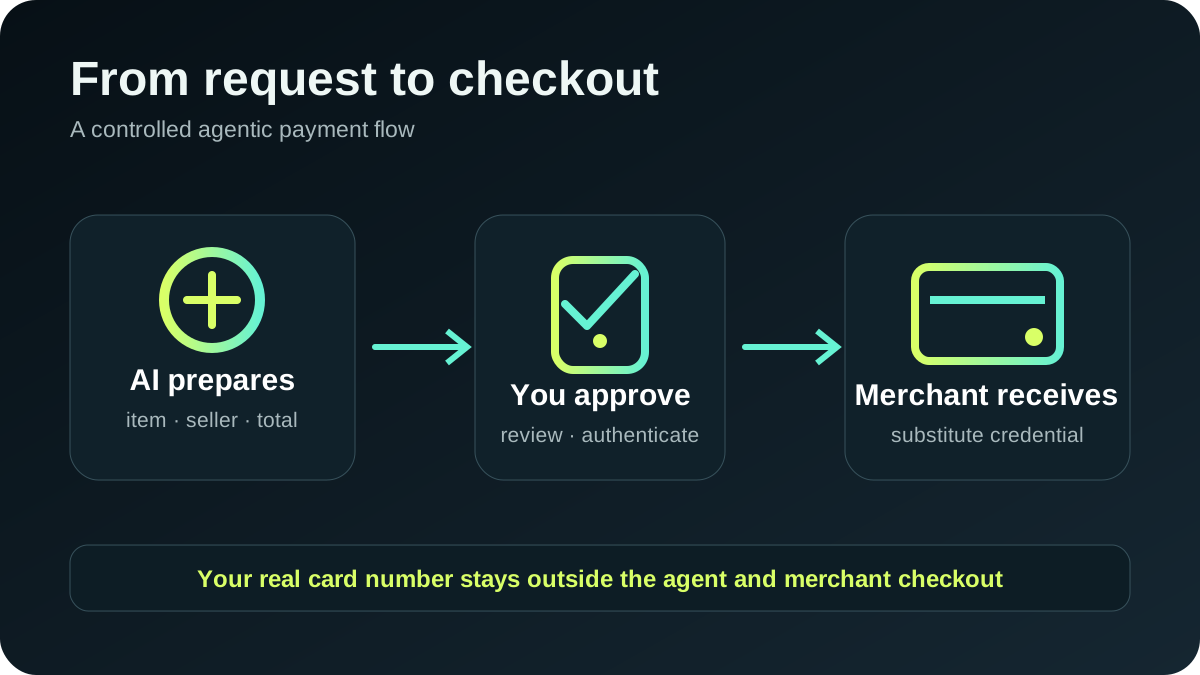
ChatGPT Wallet is OpenAI’s attempt to let an agent move from researching a purchase to paying for it—while keeping the user in control of the final decision. The feature saves an eligible card, supplies a substitute payment credential at checkout and asks the user to approve the purchase with a device security check.
That is a meaningful change. Most AI shopping assistants can recommend products. Wallet gives an eligible ChatGPT agent a payment mechanism. It also raises the standard for scrutiny: the moment an assistant can spend money, “close enough” is no longer a charming personality trait.
This review is based on OpenAI’s launch announcement, Help Center, Wallet privacy notice and terms, plus published payment-network materials. AIstratica has not independently tested Wallet’s reliability or merchant acceptance.
What ChatGPT Wallet actually is
Wallet is a payment feature inside dots, OpenAI’s agent experience. It is initially rolling out to ChatGPT Pro subscribers who are at least 18, live in the United States, have a U.S. billing address and use an eligible U.S.-issued American Express, Mastercard or Visa card. Availability is gradual, so meeting those conditions does not guarantee immediate access.
It is not a bank account, stored-value balance or new credit line. Your existing card issuer still handles the underlying card relationship. OpenAI says the selected card keeps its normal rewards and eligible dispute protections.
When you approve a purchase, Wallet creates or uses a substitute payment credential—described in the Help Center as a virtual card number—for the agent to enter at checkout. The business and agent do not receive your real card number. The merchant still decides whether it can accept the transaction, and a Wallet approval is not proof that the order succeeded. You should check the merchant’s confirmation.
The purchase flow in plain English
1. The agent helps prepare the order
You can ask a dot to research a product or service, compare options and prepare a purchase. A careful request should specify the item, maximum total cost, delivery destination, required features and any conditions such as free returns.
The agent may browse a merchant’s site and place an item in a checkout flow. The merchant remains responsible for the product description, inventory, price, delivery and customer service. Wallet does not turn an unreliable shop into a reliable one.
2. You review the important details
Before payment, the approval screen should show the merchant, items, total and selected card. Check taxes, delivery charges, recurring terms and the exact product variant. A blue suitcase in the basket is not helpful if you wanted black, cabin-size and delivered before Tuesday.
OpenAI’s launch materials say each purchase requires a security check. The release notes describe biometric approval such as Face ID or Touch ID on a supported device. If approval is unavailable on the current device, the Help Center says a link or QR code can continue the process on a supported device signed into the same account.
3. Wallet supplies a substitute credential
After approval, the agent receives a payment credential linked to the selected card. It can use that credential at checkout without seeing the real card number or security code.
Tokenisation reduces exposure of the underlying card details. It does not eliminate every risk. A purchase can still be made with the wrong quantity, sent to the wrong address or rejected by a merchant. Fraud controls can also decline a legitimate agent transaction.
4. The merchant must confirm the order
The final proof is the merchant’s order confirmation. If the merchant accepts the purchase, it handles fulfilment, refunds and cancellations under its own policies. OpenAI’s terms say users generally need to contact the merchant—not Wallet—to cancel an order or manage a recurring charge.
A realistic first project
If Wallet appears in your account, begin with a low-cost, non-urgent purchase from a merchant you already trust. Avoid medication, travel with strict cancellation rules, scarce event tickets or anything whose wrong specification would create a serious problem.
Try a request such as:
Find two USB-C laptop chargers from the manufacturer’s official store. Each must support at least 65 W USB Power Delivery, include the correct cable, cost no more than US$60 including tax and standard delivery, and allow returns. Compare the warranty and delivery date. Do not purchase anything until I review the merchant, exact model, total and address.
Before approving, verify:
- Seller: Is this the official store or an authorised retailer?
- Specification: Does the charger support the correct wattage and connector?
- Full cost: Are tax, delivery and any add-ons included?
- Delivery: Is the address correct and the date realistic?
- Terms: Is this a one-off purchase, and is the return policy acceptable?
After approval, wait for the merchant’s confirmation and compare it with the approved details. The goal is not to prove the agent can click “buy.” It is to learn whether the entire chain—from research to fulfilment—remains understandable and controllable.
The safeguards that matter
Real card details stay out of the agent’s hands
OpenAI says its payment service provider collects the full card number, expiry date, security code and billing information. OpenAI receives a tokenised credential and limited card details, including the network, issuer, type, last four digits, expiry date and eligibility signals. The agent and merchant receive the substitute credential needed for checkout, not the underlying card number.
This is better than pasting card details into a chat. Users should never send a card number or security code in an ordinary prompt.
Approval creates a deliberate pause
Requiring the user to review and authenticate a purchase helps prevent an agent from silently completing an unexpected transaction. That safeguard is only as good as the review. If users approve a screen as casually as they dismiss a cookie banner, the security pause becomes theatre.
Existing payment protections may still apply
OpenAI says eligible rewards and dispute protections remain attached to the card. The exact protection depends on the issuer, network, transaction and applicable terms. Wallet does not promise a refund or replace the issuer’s dispute process.
Privacy: the card number is only part of the story
The privacy benefit is specific: OpenAI says it does not receive the full card number or security code, and the merchant and agent do not receive the real card details.
Wallet still processes a substantial transaction record. Its privacy notice lists contact and delivery information; merchant, amount and currency; items and quantities; tax, fees, shipping and discounts; approval or rejection records; authentication results; device and time; fulfilment, cancellation, refund, dispute and chargeback status.
Removing a card prevents new Wallet payments with that credential, but does not cancel existing orders or automatically erase all Wallet records. OpenAI and its providers may retain information to complete transactions, prevent fraud, resolve disputes or meet legal obligations. Merchants, banks and card networks also process information under their own notices.
For a sensitive purchase, ask whether the convenience is worth adding the transaction to an AI-mediated workflow. A substitute card number protects the credential; it does not make the purchase itself private.
Pricing and availability
Last checked: 16 November 2026. OpenAI has not published a separate Wallet usage fee in the official materials reviewed. Access currently requires an eligible ChatGPT Pro subscription and remains limited to the initial U.S. rollout.
| Item | Published position |
|---|---|
| Wallet fee | No separate consumer Wallet fee was listed in the reviewed launch, Help Center or terms. Merchant charges, taxes, delivery and card costs still apply. |
| Required ChatGPT plan | Eligible ChatGPT Pro subscription. OpenAI currently lists Pro 100 at US$100/month, Pro 200 at US$200/month and Pro 500 at US$500/month. Wallet availability may vary during rollout. |
| Geography | Initial rollout: adults in the United States with a U.S. billing address. |
| Cards | Eligible U.S.-issued American Express, Mastercard and Visa cards. |
| Merchant support | Not every website supports agent purchases. Merchant acceptance and order confirmation are separate from Wallet approval. |
Check OpenAI’s Wallet announcement, Wallet Help Center guide and current Pro plan information before relying on access or price details.
For readers outside the United States, including Pakistan, Wallet is not part of the announced initial availability. Do not pay a third party promising to “unlock” it or misrepresent your location and billing details.
ChatGPT Wallet versus familiar checkout options
| Option | What it is good at | Where Wallet differs |
|---|---|---|
| Browser autofill | Quickly enters your saved address and card into a checkout you control | Wallet lets an agent conduct more of the shopping flow and uses a substitute credential |
| Apple Pay or Google Pay | User-controlled tokenised payment at supported checkouts | Wallet is designed for an AI agent to use after the user approves the prepared purchase |
| Merchant wallet or Shop Pay | Fast checkout within a merchant or participating network | Wallet aims to work across agent-compatible merchants rather than one shop account |
| Virtual card from a bank | Limits exposure of the real card number | Wallet combines substitute credentials with an AI shopping and approval workflow |
The right choice depends on the task. If you already know what to buy, conventional wallet checkout may be faster and simpler. ChatGPT Wallet becomes interesting when the agent has done useful comparison work and can carry the same verified details into checkout.
Where Wallet may struggle
Merchant compatibility is incomplete. Some sites may block agents, reject virtual credentials or require interactions the agent cannot complete.
The agent can misunderstand the request. Tokenised payment does not correct a wrong size, date, address or subscription term.
Approval is not fulfilment. A merchant can decline, cancel or alter availability after the user approves. Always check the order confirmation.
Returns remain fragmented. The merchant usually handles cancellation, return and refund requests. Wallet is not a universal customer-service desk.
Access is narrow. The initial rollout excludes most countries and non-Pro users. That makes it a developing feature rather than a general recommendation for international readers.
Transaction data is detailed. The real card number is protected, but OpenAI and other parties still process purchase, delivery and authentication information.
AIstratica’s verdict
ChatGPT Wallet addresses a real weakness in agentic shopping: an AI cannot complete a purchase safely by simply asking the user to paste payment details into a conversation. Substitute credentials, a visible approval screen and device authentication create a more defensible design.
The more important test is operational. Can the agent preserve the correct product, seller, total, delivery and terms from research to merchant confirmation? OpenAI’s documentation gives the user meaningful control points, but it does not guarantee that every website, order or recommendation will work correctly.
For eligible U.S. Pro users, Wallet is worth trying with a small, reversible purchase from a familiar merchant. Review every field and confirm the order independently. For everyone else, it is best understood as an early view of agentic commerce—not a reason to reorganise your shopping life around a feature you cannot yet access.
Best for: Eligible U.S. ChatGPT Pro users who already use a dot to compare ordinary products and want a controlled path to checkout.
Biggest strength: The agent can pay without receiving the real card number, while the user reviews and authenticates each purchase.
Biggest limitation: Limited rollout and merchant support, plus the ordinary but serious risk that an agent prepares the wrong order correctly.
Sources and editorial disclosure
- OpenAI, Introducing ChatGPT Wallet, 13 November 2026.
- OpenAI Help Center, Making purchases with ChatGPT Wallet.
- OpenAI, ChatGPT Wallet Privacy Notice, effective 12 November 2026.
- OpenAI, ChatGPT Wallet Terms, effective 12 November 2026.
- OpenAI Help Center, About ChatGPT Pro tiers.
- Visa, Visa partners with OpenAI to power agentic commerce, 10 June 2026.
This is an independent, research-based review. AIstratica has no stated commercial relationship with OpenAI and did not conduct a hands-on performance test. Last fact-checked: 16 November 2026.