NEW · THE AI POWER RACE · 18 NOVEMBER 2026
Two Flagships in Two Days: What GPT-6.2 and Qwen4-Max Reveal About the AI Power Race
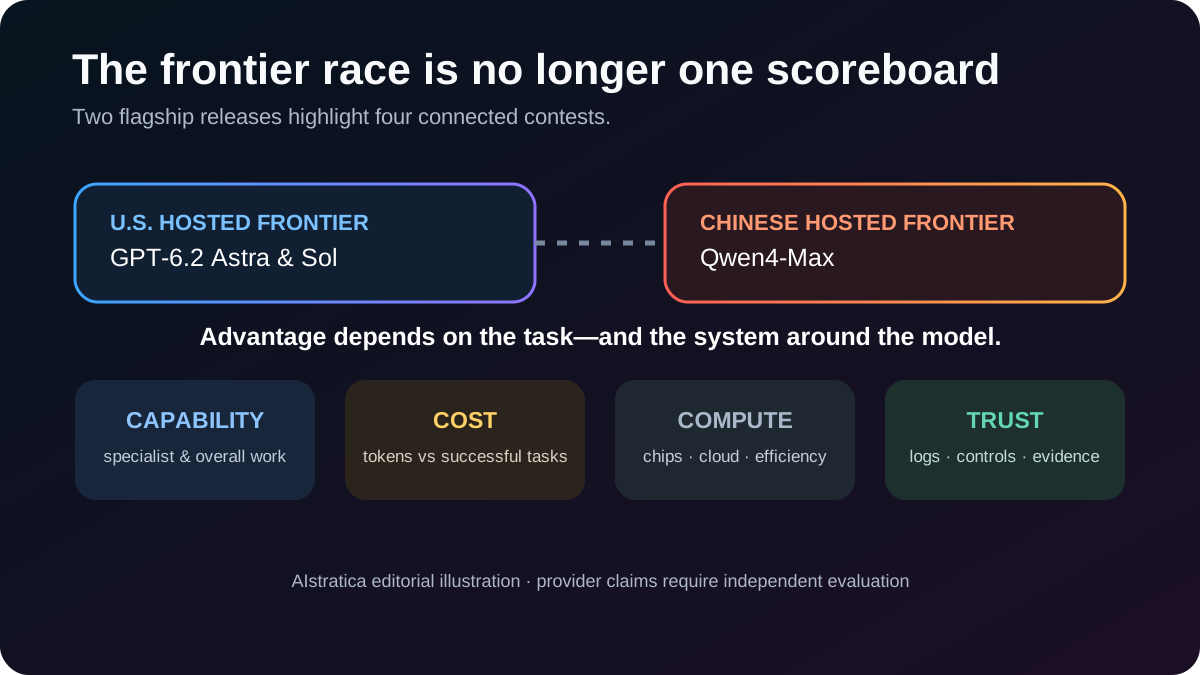
Alibaba released Qwen4-Max on 16 November. OpenAI followed on 17 November with GPT-6.2 Astra and GPT-6.2 Sol. A calendar is not proof of coordination, retaliation or technological parity. It is, however, a useful snapshot of how quickly the frontier has become a contest over capability, cost, deployment and trust at the same time.
The releases also complicate an easy political story. The competition is not simply American closed models against Chinese open models. Both new flagships are hosted, closed-weight services. Alibaba says smaller Qwen4 models will later receive open weights. OpenAI is selling two capability tiers and emphasising lower task cost, stronger safeguards and professional workflows.
What OpenAI announced
OpenAI describes GPT-6.2 Astra as its model for the hardest professional work and GPT-6.2 Sol as the everyday option. Both are available in ChatGPT Work and Codex for eligible paid users and through the API.
The company's standard API prices are:
| Model | Input per million tokens | Cached input | Output |
|---|---|---|---|
| GPT-6.2 Astra | US$8 | US$0.40 | US$40 |
| GPT-6.2 Sol | US$2 | US$0.10 | US$10 |
OpenAI says Astra's input and output prices are 20% lower than GPT-6 Astra's and highlights gains in professional documents, coding, science and computer use. These are vendor results. They should be treated as release evidence, not an independent universal ranking.
The accompanying system card contains the more strategically important information. OpenAI classifies both models at the Critical threshold for cybersecurity capabilities and the High threshold for biological and chemical capabilities. It classifies Astra at the High threshold for AI self-improvement—the first externally released OpenAI model to reach that level under its framework.
Those classifications do not mean the model autonomously redesigns itself or that harm is inevitable. They mean OpenAI's internal evaluation crossed defined capability thresholds and triggered additional safeguards, monitoring and access controls.
Qwen4-Max represents a different commercial route
Alibaba's Qwen4-Max arrived one day earlier as a hosted flagship with native multimodal input, a one-million-token context window and tool calling. Its international Singapore pricing is listed at US$1.50 per million input tokens and US$4.50 per million output tokens.
Price comparisons need care. Token prices do not measure accuracy, latency, tool reliability, regional availability or the number of tokens a model needs to finish a task. OpenAI's public benchmark claims and Alibaba's public benchmark claims also use provider-selected configurations. The sensible comparison is a common workload, a fixed quality threshold and the complete cost of a successful result.
Still, the gap in listed token prices matters commercially. Chinese providers can use aggressive API pricing and open-weight follow-on models to widen adoption, especially among developers who cannot justify premium frontier rates. American providers can answer with stronger specialist performance, enterprise integrations and safeguards that regulated customers value.
Closed flagships and open ecosystems can coexist
The latest releases show why “open versus closed” is an ecosystem choice rather than a national personality test.
A hosted flagship gives a company control over updates, safety layers, billing and enterprise support. Smaller open-weight releases can spread the developer ecosystem, encourage local deployment and reduce dependence on a single API.
Chinese developers have strong incentives to support both routes. Hosted models generate cloud revenue, while open weights can increase global experimentation and reduce exposure to foreign API restrictions. American companies also mix approaches through partnerships, licensed weights and third-party open models, even when their most capable systems remain closed.
Capability is becoming harder to govern
OpenAI's self-improvement and cybersecurity classifications make the governance problem more concrete. A model that can assist research, code and long-horizon workflows may improve productivity and also lower barriers to misuse.
On the same day, Microsoft announced an AI Transparency Initiative with more than 40 organisations. Its stated principle is that greater autonomy requires greater transparency. Microsoft argues that organisations should be able to see what an agent was asked to do, which data and tools it accessed and which actions it took—and verify that evidence independently rather than relying only on the model's account.
That approach addresses a weakness shared by every national ecosystem. A fluent model can explain its action after the event, but its explanation is not automatically an audit log. Good governance needs records from the surrounding identity, runtime and policy systems.
The U.S.–China contest is also a supply-chain contest
Model releases sit on top of chips, memory, networking, electricity, data centres and software. The United States is using export controls and cloud-access rules to limit some advanced compute pathways. China is investing in domestic accelerators, model efficiency, cloud capacity and open-weight distribution.
Other countries are not spectators. Taiwan and South Korea remain critical to advanced manufacturing and memory. Japan and the Netherlands supply specialised equipment. Singapore, Malaysia, Indonesia, Thailand and Brazil are increasingly important data-centre locations and now face closer scrutiny under the U.S. remote-compute rule announced on 16 November.
A model can be trained by one company, served from another country, built on chips fabricated in a third and used by customers everywhere. National labels remain politically powerful, but the physical system is multinational.
Possible action–reaction dynamics
The new releases support several cautious inferences.
Price pressure may accelerate
Low Chinese API prices can push American providers to improve efficiency and offer cheaper tiers. Premium American models may push Chinese firms to invest in specialist capability and enterprise reliability.
Controls may strengthen substitution incentives
Restrictions can reduce access to advanced U.S. chips while increasing the strategic value of domestic hardware and software optimisation. That incentive does not guarantee rapid technical substitution; manufacturing yield, memory, interconnects and developer tools remain difficult constraints.
Stronger models may produce stronger monitoring
As capability thresholds rise, providers and governments may demand more logging, identity checks, model evaluations and restricted access. These measures can reduce risk and also concentrate power in large platforms able to afford compliance.
Open weights may become the distribution counterweight
If hosted access becomes more controlled, open-weight models can provide researchers and companies with an alternative route. They also transfer more safety responsibility to deployers and can spread capable systems beyond the original provider's oversight.
None of these outcomes is automatic. They are mechanisms to watch, not predictions dressed as certainty.
What independent evidence is still needed
The most important questions cannot be answered by launch pages alone:
- How do GPT-6.2 and Qwen4-Max perform on the same realistic tasks under the same rules?
- What is the cost per verified successful task rather than per token?
- How often do agents disclose blockers, tool failures and uncertainty?
- Which safeguards remain effective when models use external tools over long workflows?
- Can Chinese accelerators and software stacks support frontier deployment at scale?
- Do remote-compute controls reduce restricted access or merely redirect infrastructure and customers?
Independent evaluations, operational data and transparent policy implementation will matter more than a single leaderboard.
AIstratica's assessment
Two flagship releases in two days do not prove a symmetrical race. They show two large ecosystems competing with different combinations of capability, cost, cloud distribution and openness.
The strategic contest is moving beyond the question of who has the smartest chatbot. It now includes who can deliver reliable work at acceptable cost, who controls the compute underneath it and who can show what an increasingly autonomous system actually did.
That last question may become decisive. Capability attracts users. Price attracts developers. Trust determines whether governments and large organisations permit the system to act.
Sources and disclosure
- OpenAI: Introducing GPT-6.2 Astra and Sol, 17 November 2026
- OpenAI GPT-6.2 system card, 17 November 2026
- Microsoft AI Transparency Initiative, 17 November 2026
- Alibaba Cloud Qwen4-Max announcement, 16 November 2026
- Alibaba Cloud Qwen4-Max documentation
- U.S. BIS remote-compute rule announcement, 16 November 2026
This article separates provider claims from AIstratica's analysis. It does not treat release timing as evidence of causation or claim independent benchmark testing. Last fact-checked: 18 November 2026.