NEW · THE AI POWER RACE · 17 NOVEMBER 2026
The Chip Border Moves to the Cloud: America’s Remote-Compute Rule and China’s Qwen4 Moment
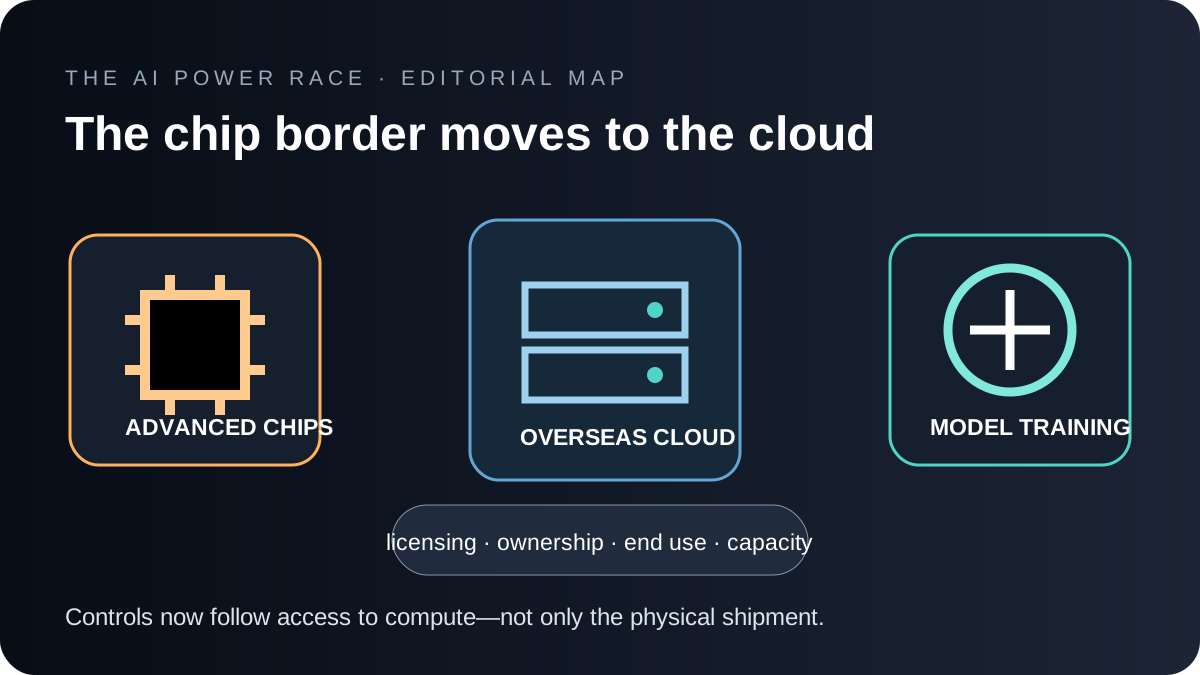
Export controls traditionally follow hardware: a chip crosses a border, a licence is checked and customs has something physical to inspect. Cloud computing complicates that picture. A restricted company may never import an advanced accelerator. It can try to rent access to one installed in a third-country data centre.
On 16 November 2026, the U.S. Bureau of Industry and Security announced an interim final rule intended to address that route. The same day, Alibaba released Qwen4-Max, its new closed-weight flagship model, with smaller open-weight Qwen4 models promised later.
The timing is strategically revealing, but it does not establish causation. There is no evidence that Alibaba released Qwen4-Max in response to the new rule, and AIstratica found no official Chinese government response by the time of publication. What the two developments show is a competition operating simultaneously at different layers: access to advanced compute, cloud governance, model efficiency and global distribution.
What the U.S. rule says
The BIS document, RIN 0694-AK50, would create a licence requirement when specified advanced U.S.-technology chips support data centres that provide more than 12 million aggregate TPP of compute to companies headquartered in Macau or a Country Group D:5 destination, including China. The rule covers linked data centres, including digitally connected facilities that pool resources.
It also creates destination-based licence requirements for advanced chips going to Indonesia, Malaysia, Singapore, Thailand and Brazil, subject to stated exceptions and reporting conditions for qualifying U.S.-headquartered companies. BIS says those countries present a higher-than-normal diversion risk; that is the U.S. government’s assessment, not an independently established fact about every operator in those markets.
The draft requires data centres, exporters, foundries and chip packagers to conduct customer and ownership due diligence. It preserves an exception for systems used exclusively as commercial recommender systems, while excluding generative systems from that definition.
The document also formally rescinds the earlier AI Diffusion Rule and removes its model-weight controls, shifting the emphasis toward more targeted destination and end-use restrictions.
The legal status needs careful wording
BIS announced and displayed the interim final rule on 16 November. The 132-page document still contains placeholders for the Federal Register publication date, effective date, docket number and comment deadline. Its text says the rule becomes effective on publication in the Federal Register and comments are due 60 days later.
That means the policy is announced and the rule text is public, but AIstratica is not treating placeholder dates as completed legal events. Companies should use the final Federal Register publication and professional compliance advice before changing operations.
Why controlling remote compute is harder than controlling a shipment
A physical shipment has identifiable parties, quantities and destinations. Remote access can be reassigned, divided across facilities and delivered through layers of cloud customers and contractors.
The rule responds by using ownership, end-use, knowledge and aggregate compute thresholds. This broadens the compliance question from “where is the chip going?” to “who ultimately controls the workload, how much compute can they access, and what is the system used for?”
That may close a real enforcement gap. It also creates difficult measurement problems:
- A cloud provider must identify indirect ownership and control.
- Linked facilities may need to aggregate capacity across borders.
- A customer’s end-use can change after the original shipment.
- Commercial recommendation and generative-model workloads can share infrastructure.
- U.S. rules must be implemented by foreign operators that also answer to local law and commercial customers.
The rule’s effectiveness will therefore depend on auditability and cooperation, not only the wording of the threshold.
Southeast Asia and Brazil move closer to the centre of the contest
Singapore and Malaysia are major data-centre markets; Indonesia, Thailand and Brazil are expanding digital infrastructure. A new licence layer can increase compliance costs, delay deployments and influence where cloud capacity is built.
The stated U.S.-headquartered-company pathway may protect some American-operated capacity, but it could create different burdens for local and non-U.S. firms. Governments in affected countries may face a three-way problem: maintain access to U.S. chips, avoid becoming a diversion route and preserve an attractive investment environment.
This is where U.S.–China competition becomes a wider supply-chain question. The choices of Singaporean regulators, Malaysian data centres, Taiwanese foundries, Korean memory suppliers, Japanese equipment firms and Dutch lithography companies all shape the practical result.
Qwen4-Max shows the other side of the race
Alibaba’s Qwen4-Max launch is a model and platform event, not proof that export controls have failed. The company says the model uses a 2.4-trillion-parameter mixture-of-experts architecture while activating 71 billion parameters per token. It offers a one-million-token context window and is available through Alibaba’s cloud and workplace products.
Alibaba also advertises international API prices of US$1.50 per million input tokens and US$4.50 per million output tokens in Singapore. Pricing a flagship aggressively is part of platform competition: developers compare not only benchmark scores but also latency, tool reliability, data location and the cost of serving millions of requests.
The release complicates the simple claim that American frontier models are closed while Chinese models are open. Qwen4-Max is closed-weight. Alibaba says smaller Qwen4 models will later be open-weight. China’s ecosystem is using both approaches: hosted flagships can support commercial control and cloud revenue, while open models can widen adoption and reduce dependence on foreign APIs.
Possible action–reaction dynamics
AIstratica’s analysis is that the new rule may produce several responses, none of which is guaranteed.
More compliance and cleaner ownership records
Major data centres may strengthen customer screening, capacity accounting and contractual controls. This would support enforcement but raise costs for legitimate users.
More demand for non-U.S. compute stacks
Restrictions on U.S.-origin chips can increase the commercial value of Chinese accelerators, software optimisation and domestic cloud capacity. Substitution is constrained by performance, yield, memory, interconnects and software support; strategic demand does not create mature supply overnight.
Greater emphasis on efficient model architectures
Mixture-of-experts designs, quantisation, better scheduling and inference optimisation can stretch limited hardware. Efficiency does not eliminate the value of large compute clusters, but it can change how much capability is obtained from each unit of compute.
Fragmentation of cloud and model ecosystems
Providers may separate regions, customers and model offerings more sharply. A fragmented system can reduce some security risks while raising costs, duplicating infrastructure and making international research collaboration harder.
What would count as evidence of success?
The rule should eventually be judged against observable outcomes rather than political language.
Useful indicators include whether prohibited entities lose access to controlled compute, whether diversion networks are detected, how licensing times affect legitimate data-centre investment, whether non-U.S. accelerators gain market share and whether model developers materially change training strategies.
It will also matter whether partners view the controls as targeted and workable. A rule enforced without reliable allied cooperation may redirect transactions rather than remove them.
AIstratica’s assessment
The United States is trying to move export control from the shipping dock into the cloud account. That is a logical response to remote access, but it asks regulators and companies to measure an invisible service delivered across corporate and national boundaries.
China’s parallel challenge is different: continue improving models and cloud platforms under constrained access to the most advanced foreign hardware. Qwen4-Max is evidence of continued product development, not a definitive measure of the underlying compute gap or the future effectiveness of controls.
The strategic risk is a familiar spiral. Tighter controls can reduce access and also strengthen incentives for substitution. Faster Chinese model releases can be read in Washington as evidence that remaining access routes must be closed. Each side may describe its move as defensive while the other experiences it as pressure.
Good policy requires more than a larger fence. It requires measurable objectives, allied consultation, enforceable thresholds and regular assessment of whether restrictions reduce security risk without unnecessarily accelerating technological separation.
Sources and disclosure
- U.S. Bureau of Industry and Security announcement, 16 November 2026
- BIS interim final rule on display, RIN 0694-AK50
- Alibaba Cloud Qwen4-Max launch announcement, 16 November 2026
- Alibaba Cloud Model Studio documentation
This article distinguishes official claims from AIstratica’s interpretation. No causal relationship between the U.S. rule and Alibaba’s release is asserted. Last fact-checked: 17 November 2026.