NEW · AI TOOL OF THE DAY · 17 NOVEMBER 2026
Qwen4-Max: A Million-Token Teammate With a Smaller Price Tag
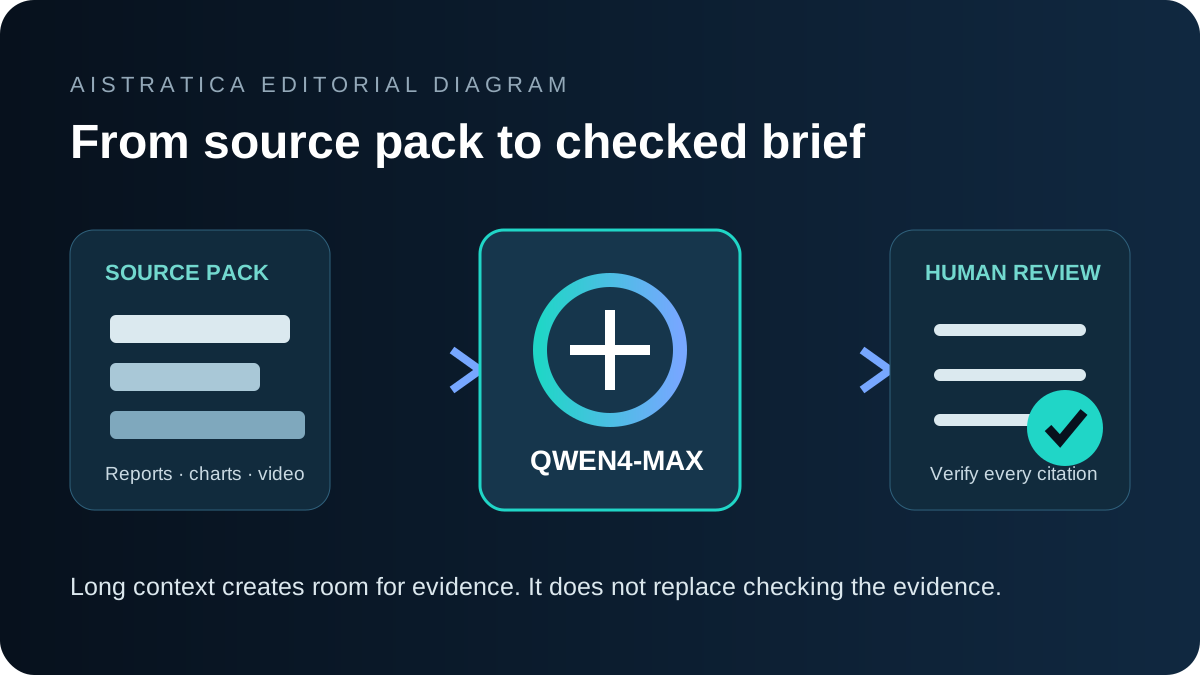
You have a 180-page report, four spreadsheets, a recording of yesterday’s meeting and a deadline that appears to be moving closer out of personal spite.
Alibaba’s new Qwen4-Max is built for this sort of untidy knowledge work. It accepts text, images and video; can use tools and web search; and offers a one-million-token context window. In plain English, it can work with far more material in one session than most people would willingly read before lunch.
That does not mean it understands every page perfectly, and it certainly does not turn unverified documents into verified facts. But for developers and professional users who already work in Alibaba’s cloud ecosystem, Qwen4-Max is a notable new option.
This review is based on Alibaba Cloud’s launch announcement, Model Studio documentation and privacy policy. AIstratica has not independently benchmarked the model.
What Qwen4-Max is
Qwen4-Max is Alibaba’s flagship closed-weight multimodal model released on 16 November 2026. Alibaba describes a sparse mixture-of-experts architecture with 2.4 trillion total parameters and 71 billion activated for each token. Those figures describe the architecture; they are not a guarantee that the model will outperform every rival on your task.
The production model is available through Alibaba Cloud Model Studio, QwenCloud, QwenWork and QwenStudio. Developers can call it using Alibaba’s DashScope interface or compatibility layers for OpenAI Chat Completions, OpenAI Responses and Anthropic Messages.
It is designed for coding, office productivity, visual document analysis and agentic workflows. The model accepts text, images and video and returns text. Its documented tools include web search, function calling, parallel tool calling and structured JSON output.
Who benefits most
Developers migrating an existing assistant
API compatibility can reduce the amount of plumbing needed to test Qwen4-Max in an application already built around OpenAI- or Anthropic-style messages. Compatibility is not identity: parameter behaviour, tool schemas, reasoning output and safety responses still need regression testing.
Analysts working with large document collections
The one-million-token context window can accommodate substantial source packs. A policy team could provide a long report, annexes and meeting notes, then ask for a source-linked issue map. The useful word is could. Long context provides room; it does not guarantee flawless retrieval from every corner of the room.
Teams building multimodal workflows
Qwen4-Max can read screenshots, charts and video alongside text. That makes it relevant for tasks such as comparing interface mock-ups, extracting claims from presentation slides or converting a recorded product demonstration into a structured checklist.
What the documentation actually promises
Alibaba documents a one-million-token context window, up to 131,072 output tokens in non-thinking mode and up to 262,144 tokens shared between reasoning and the final answer in thinking mode. The international service is listed in Singapore, while global deployment scopes are also documented for Frankfurt, Virginia, Tokyo and Hong Kong.
The service supports streaming, prompt caching, encrypted reasoning state and reasoning-effort controls. It does not currently list batch inference, fine-tuning or private model deployment for Qwen4-Max. That matters for teams that need bulk offline processing, customised weights or an isolated deployment.
Alibaba reports strong results on coding, agent and workplace benchmarks, including sixth place on Code Arena at launch. These are vendor-reported results. AIstratica has not independently reproduced them, and benchmark strength should be treated as a reason to evaluate the model—not as proof that it will understand your company’s most chaotic spreadsheet.
A realistic beginner project: turn a source pack into a decision brief
Start with a low-risk project whose claims you can check. Use a public report, its appendices and a few related charts rather than confidential client files.
Ask Qwen4-Max to produce a two-page decision brief with four sections: the decision, the strongest supporting evidence, the strongest counter-evidence and unresolved questions. Require a source reference for every factual claim and tell the model to mark anything it cannot locate.
Use a prompt like this:
> Read the attached report, annexes and charts. Prepare a concise decision brief for a non-technical manager. Use only the supplied files. For every factual statement, cite the file name and page or section. Separate verified findings, author assumptions and your own synthesis. If a claim cannot be traced to the source pack, label it “not verified.” End with five questions a human reviewer should answer before acting.
Then perform the part no model can responsibly skip:
- Open every cited page and confirm that it supports the sentence.
- Check totals, dates, units and negative numbers manually.
- Look for evidence the summary omitted because it did not fit the proposed conclusion.
- Remove sensitive material before uploading, or use an approved enterprise environment.
- Compare one important section with another model or a human analyst.
The goal is a faster first draft, not a machine-issued decision. If the brief is wrong, “but the context window was enormous” will not comfort the meeting.
Pricing checked on 17 November 2026
Alibaba Cloud Model Studio lists the international Singapore deployment at US$1.50 per million input tokens and US$4.50 per million output tokens for both thinking and non-thinking modes. The same documentation lists a conditional free quota of one million tokens, valid for 90 days from the relevant activation, release or approval date.
Other documented regions show different prices. Frankfurt, Virginia, Tokyo and Hong Kong list approximately US$1.413 input and US$4.24 output per million tokens. Taxes, currency conversion, separate tool use and changing regional terms can alter the real bill.
Alibaba’s launch announcement also advertises implicit cache-hit input at US$0.075 per million tokens. That is a cache price, not the price for every fresh prompt. Reusing a stable prefix can lower costs; sending a completely new 700-page archive each time will not magically receive the headline rate.
Check the current Qwen4-Max documentation before budgeting.
Qwen4-Max compared with practical alternatives
| Option | Consider it when | Main trade-off |
|---|---|---|
| Qwen4-Max | You need long context, multimodal input, tool calling or Alibaba-cloud deployment | Closed weights; vendor claims and your workflow still need evaluation |
| Qwen3.8-Max | You already run a stable Qwen workflow and do not need the newest model | Older flagship; Qwen4-Max is documented as cheaper in several regions |
| Gemini 4 Carbon | You need Google’s frontier model and Google ecosystem integrations | Different pricing, governance and API behaviour require a fresh evaluation |
| Smaller open-weight Qwen models | You need downloadable weights, local control or custom deployment | Hardware, security, maintenance and model quality become your responsibility |
Alibaba says smaller Qwen4 models will be released with open weights. Qwen4-Max itself is offered as a hosted model, not a downloadable open-weight release. That distinction matters: a model can come from an ecosystem known for open weights without the flagship itself being open.
Privacy, data location and licensing
Alibaba Cloud’s international privacy policy says it records service activity and may process customer or end-user data on behalf of cloud customers. It also describes international transfers and region-specific controllers. Organisations should select an appropriate deployment region, review the service agreement and data-processing terms, and confirm whether prompts or outputs may contain personal, regulated or proprietary information.
Do not upload confidential contracts, unpublished research, medical information or customer records simply because the interface makes it easy. A convenient upload button is not a data-governance policy.
Qwen4-Max is a hosted service. Its outputs and commercial use remain subject to the applicable Alibaba Cloud terms, local law and the rights attached to source material supplied by the user. The announced future open-weight Qwen4 models will require their own licences to be checked when released.
Limitations to understand before paying
- Long context is not perfect memory. Important details can still be missed, distorted or cited incorrectly.
- Benchmark results are not your workload. Alibaba’s published scores should be independently evaluated against representative tasks.
- No fine-tuning or private deployment is listed. Teams needing weight-level customisation must choose another route.
- Tool use adds failure points. A model can call the wrong function correctly or carry an incorrect assumption through several steps.
- The flagship is closed-weight. You cannot inspect or host Qwen4-Max as you could a genuinely open-weight model.
- Regional governance matters. Data location, organisational policy and sector rules may determine whether the service is appropriate.
AIstratica’s verdict
Qwen4-Max is worth evaluating if long documents, multimodal evidence and multi-step tool use are central to your work. Its published international API price is aggressive for a flagship model, and compatibility with familiar API formats lowers the cost of a careful trial.
The sensible first step is not moving an entire production system. Run a small evaluation with public or synthetic data, define correctness criteria before seeing the output and measure citation accuracy, latency, cost and tool failures. Compare it with the model you already use.
Qwen4-Max may be a capable teammate. It still needs a job description, supervision and someone willing to check the footnotes.
Sources and editorial disclosure
- Alibaba Cloud: Qwen4-Max launch announcement, 16 November 2026
- Alibaba Cloud Model Studio: Qwen4-Max capabilities, limits and pricing
- Alibaba Cloud International Website Privacy Policy
This is an independent, research-based review. AIstratica has no stated commercial relationship with Alibaba and did not conduct a hands-on performance benchmark. Last fact-checked: 17 November 2026.